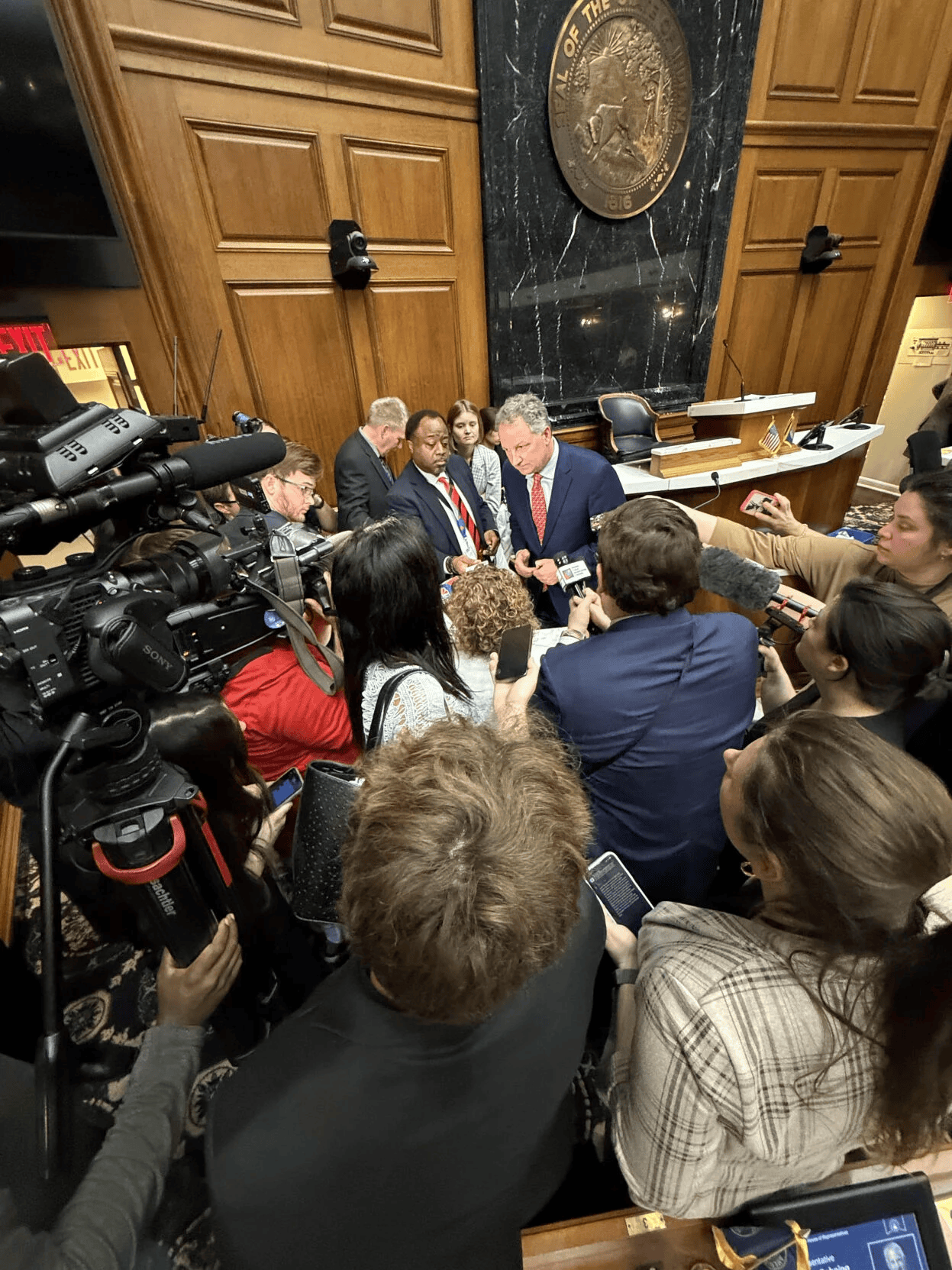
Across 30 states, college reporters are covering statehouse journalism gaps — and the experience is changing their lives.
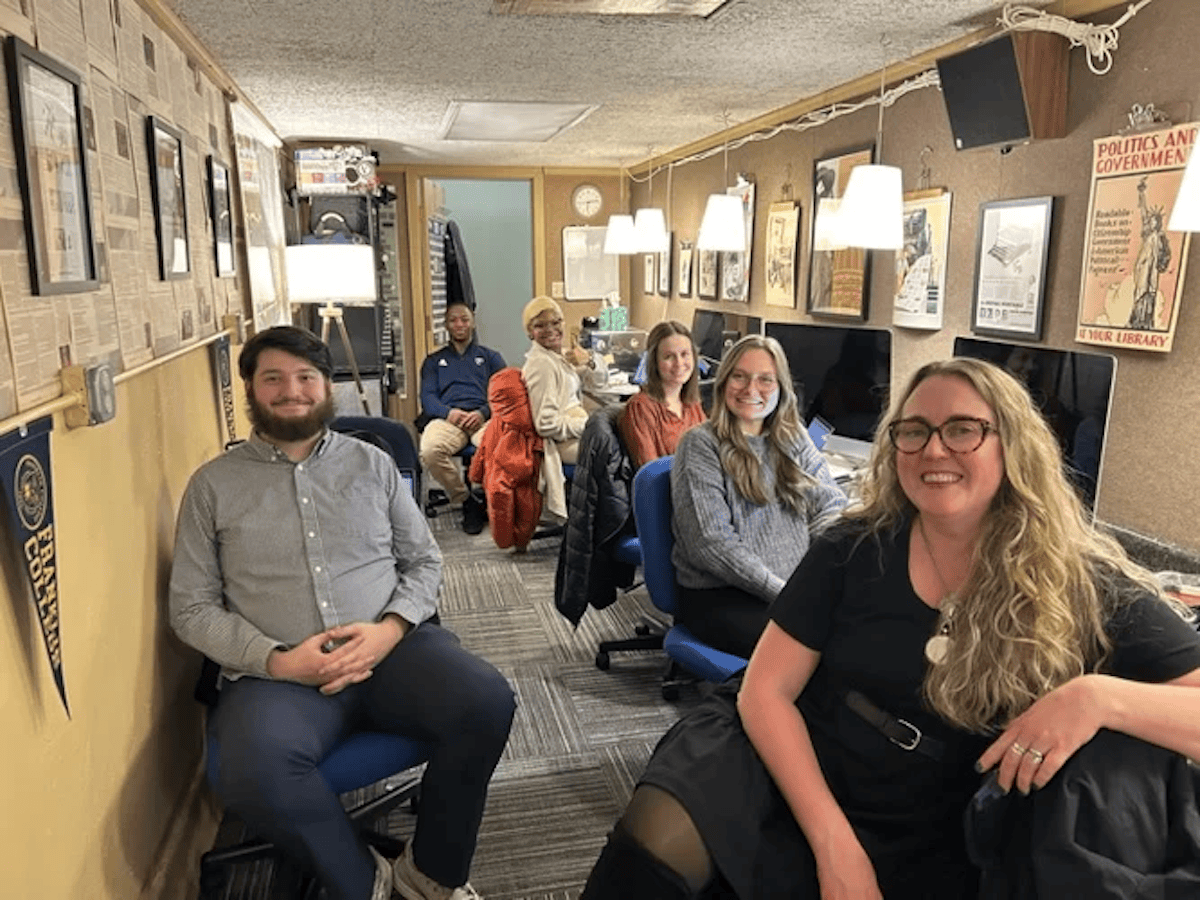
The office Colleen Steffen shares with a bunch of student journalists is far below the graceful stained glass rotunda and elegant marble floors of the Indiana Statehouse.
Their space — one of 30 or so cubicle offices now used for the working press, but rumored to have started as a horse and carriage stable — features yellowed walls and the lingering smell of hot dogs, thanks to the snack stand next to it.
But Steffen and her Franklin College students love “The Shack,” their concrete-bunker-turned-newsroom.
Steffen is the executive editor of The Statehouse File, a news outlet run by students at Franklin, a small, private, liberal arts college in Franklin, Indiana, that’s been covering the Indiana General Assembly since 2005.
Franklin is one of dozens of universities across the United States where college journalism students are reporting from statehouses. With newsrooms across the country struggling to find resources, it’s students — often in nontraditional student-media formats — filling the legislative coverage gaps.
Many point toward the University of Vermont’s Center for Community News, which launched in 2022, for supporting professors who are pushing statehouse programs. CCN’s 2025 reporting data found collegiate statehouse reporting projects at 35 universities in 30 states. Eleven of those are “newly launched, or about to start” since CCN’s last documented reporting of them in 2023.
The work done by Franklin’s students — and others in statehouse programs across the country — gives young journalists authority, confidence and invaluable experience before they turn their tassels.
“The real-world stakes is what gives it so much power for the students,” Steffen said. “That turns it from a school exercise into a real thing. And that pressure of, ‘This could be a big chance for me’ or ‘I could make a terrible mistake and get us sued for libel’ — that’s part of what makes it so impactful. They’re so exacting and hard on themselves.”
Many differences, all important
Statehouse programs vary from program to program and state to state. Some are semester-long initiatives taught once by one professor, while others are part of independent student media. Others, like Franklin, have a long-standing tradition of coverage involving all different kinds of journalism students.
Some have been around longer than others. Since 1972, the University of Illinois Springfield has enabled students to obtain a master’s in public affairs reporting. Its 10-month program is split between classroom instruction and a full-time reporting internship at the Illinois Capitol.
Other differences might include a full-time adviser designated specifically for the program, the number of credit hours students can receive, and whether it’s an internship, a capstone or has a different distinction.
One statehouse program with multiple schools under the same umbrella is the New Jersey State House News Service, which launched in summer 2023. Deb Howlett, the editor and founder of the program, is a professor at Rutgers who saw a lack of statehouse reporting in New Jersey. When Rutgers told her they didn’t have funds to start the program, she took charge.
“Well, why do I need Rutgers’ money? I could just go out and raise funds,” Howlett thought.
Since then, a handful of foundations have given Howlett donations for her program, allowing students from six New Jersey universities the opportunity to report at the Capitol.
Sarah Gamard manages a cohort of programs for CCN at the University of Vermont, which is credited with creating a surge of statehouse programs. As an undergraduate at Louisiana State University, Gamard worked at the Manship School Statehouse Bureau, LSU’s Capitol reporting program. She credits that experience for leading to a fellowship at the POLITICO Journalism Institute, after which she spent several years in journalism before joining CCN full time.
Gamard has a unique point of view, considering she’s been on both sides — benefiting from student statehouse programs and now supporting them. Her roles include “cheerleader, life coach, researcher and resource provider,” she said with a laugh.
“In my opinion, this is an invaluable way for students to get hands-on experience, as internships — especially paid internships — are harder and harder to find,” Gamard said. “What I tell a lot of faculty and what I really believe is, a student has to fulfill a certain amount of credits anyway. … It’s just invaluable experience to use those credit hours to have students graduate with a portfolio, and also filling a gap in local news and just helping newsrooms.”
John Schmeltzer has seen the gaps in local news firsthand as a journalism professor at the University of Oklahoma. Schmeltzer, co-founder of OU’s Gaylord News, which had provided coverage from D.C. since 2018, walked into the Oklahoma Capitol last fall and saw a total of just one reporter from the state’s largest newspaper. Another local reporter was on his way back to Tulsa.
“That was it,” Schmeltzer said. So they expanded Gaylord News to cover the legislature in their own backyard.
He said with two newspapers and zero television stations covering the Capitol, OU student reporters in Oklahoma City have started filling a need.
“These newspapers and television stations, if we could go give them one or two people in each of them, they would still want more,” Schmeltzer said, “because they need more.”
It’s the same story in the southeast, where Ted Bridis, founding editor of the University of Florida’s student statehouse program, Fresh Take Florida, said the press corps has “diminished.”
Despite his students working on more investigative and enterprise pieces and less day-to-day coverage, they, too, are helping fill gaps — even in the country’s third most populated state. Bridis said the Associated Press lost its statehouse correspondent before the legislative session this year and still hasn’t replaced her. Now, he said, there are questions about whether the AP will have another statehouse reporter.
If not, his crew is prepared.
“We can never fill the need of an AP or a wire service, but we can augment it,” Bridis said. “And we try to tell stories that are super important and that readers, viewers and listeners may not hear otherwise.”
Gamard said she hopes the research she and others at CCN do incentivizes other universities to understand the importance of statehouse programs. After all, nobody knows that better than her.
“My entire career is thanks to that one class I took,” Gamard said. “My entire career.”
Training the next generation
No matter how the statehouse programs are structured, students are making their presence felt. A 2023 Pew Research Center study found that almost 10% of state Capitol reporters are student journalists.
Franklin senior Anna Cecil can still recall her hands sweating the first time she pulled aside a lawmaker to ask them questions. Cecil will cover Capitol Hill this summer with Arizona State University’s Cronkite News Washington, D.C., bureau. Her time at The Shack has prepared her.
“Even though it is terrifying to go to Capitol Hill, I have the experience; I can be confident there,” she said. “I don’t have to worry about walking in and not knowing how to run up to a senator. If I had not done The Statehouse File and I had just done typical student on-campus media, there’s no way I would be prepared to go to D.C.”
Recent Franklin graduates like Taylor Wooten, who is now the city government reporter for Indianapolis Business Journal, and Alexa Shrake, who covers litigation and trials for The Texas Lawbook, said their time reporting at the Indiana statehouse for Franklin prepared them better than traditional student media or classrooms.
Shrake said when applying for her job, she spoke of covering former Franklin College president Thomas Minar’s trial in Wisconsin, in which he was charged with 12 counts of possession of child pornography, among other crimes. That experience helped Shrake discover her passion for covering law.
Before Wooten started with the Indianapolis Business Journal, she was a POLITICO Journalism Institute Fellow in June 2022, and without her Statehouse File experience, she may not have been admitted into the highly competitive program.
“You can talk about journalism so much in the classroom, and you can get into what it entails, and you can have these mock interviews with your professor, or you can be sent out, maybe into the community, and interview people, but it’s not the same impact physically, emotionally, mentally as being sent into the statehouse wearing a suit, feeling out of place and trying to pull aside a lawmaker,” Wooten said. “And I think it really helped me build confidence in myself and my reporting.”
Ashton Slaughter is a recent graduate of Oklahoma State University, where he received national awards for his work with The O’Colly, the student newspaper, and for his internship at the Tulsa World. He has also written for The Oklahoman and other outlets. PreviousIn student newsrooms, Trump’s press hostility forces editors to revise traditionNextA quarter million bylines, coming right up
The Student Press Report is a national news desk covering student media and journalism education in higher ed. It is supported by lead partners Student Press Law Center and Flytedesk, with secondary support from the Associated Collegiate Press, the Association of University Student Media Managers, the College Media Business and Advertising Managers and CollegeJournalism.org.

Leave a Reply