Student reporters at Michigan State explain how public records helped them uncover misconduct, investigations and hidden decisions.
Editor’s note: The Student Press Report is a national news desk covering student media and journalism education in higher ed. It is supported by lead partners the Student Press Law Center and Flytedesk, with secondary support from the Associated Collegiate Press, the Association of University Student Media Managers, the College Media Business and Advertising Managers and CollegeJournalism.org.
Written By Theo Scheer, Alex Walters and Owen McCarthy
You never forget your first FOIA.
The curious excitement as you press send. The anxious weeks of waiting. The rush of triumph — hopefully — when you get a response.
And when you’re a student covering a major public university, the thrill of making an authority figure show their hand never gets old.
Good reporters maintain a diverse toolbox of methods and strategies. But for us, as journalists at The State News, Michigan State University’s independent student newspaper, there’s a clear favorite.
As student journalists, we’ve used the Freedom of Information Act to take us where other reporting methods could not. Spurred by observations while reporting and real conversations with sources, we used public records requests to fill in blanks, connect dots and check our own assumptions.
When we’ve faced opposition from Michigan State University — infamous for skirting open records laws — we researched and wrote compelling appeals, publicly shamed absurd redactions and took the university to court, where we won.
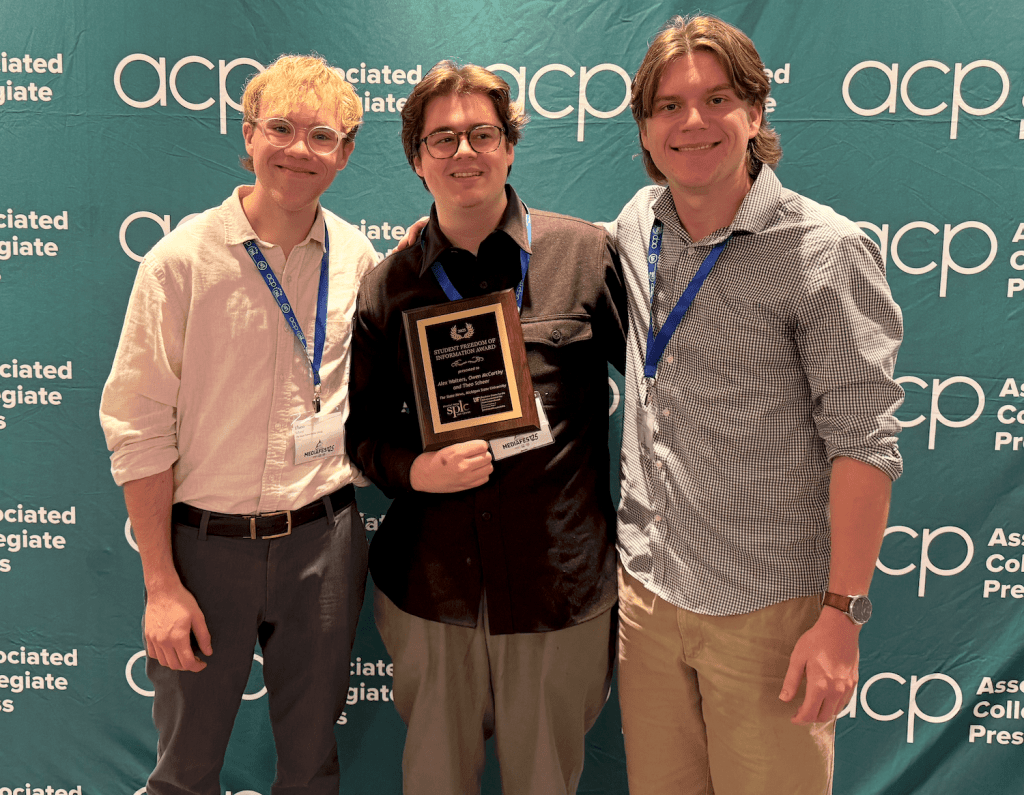
This fall, the Student Press Law Center and the Joseph L. Brechner Freedom of Information Project presented us with the 2025 Student Freedom of Information Award for our efforts.
Someone recently asked us, “How’d you learn to do all that?” It’s simple, we replied: by doing.
Requesting public records (or “FOIAing,” as reporters call it) can seem complicated and difficult. But it doesn’t have to be. It’s an easy tool and an important right that we all — student journalists in particular — should be eagerly exercising. The best way to master FOIAing is with practice. We hope you’ll turn your curiosities into discoveries and start requesting.
How we’ve used FOIA
Under the law, you can FOIA for any number of things at a public university. Emails and texts between high-level administrators? Those are public records. The terms of a controversial professor’s resignation agreement? That’s a public record. The amount of money dining halls spend on ranch dressing? Also a public record.
Open records laws were a key component in some of our wildest and most impactful stories. They helped us understand the capabilities of MSU’s AI-equipped, multimillion-dollar surveillance system, and to find examples of how it’s been used when MSU officials declined to tell us themselves. When an MSU law professor was appointed top lawyer of the Trump administration’s Federal Communications Commission, they showed the extent of his alignment with the president.
Emails and memos we got through FOIA expanded on an unreported aside in the saga of ex-doctor Larry Nassar, who sexually abused hundreds while a university physician. We found out that, a decade before his abuse went public, Nassar sought to use the blood of his young gymnasts for research.
Public records also uncovered a federal investigation into allegations of sexual assault by a campus health clinic doctor, and shed light on a sweeping institutional assessment that seeks to address such issues.
Still, we’ve learned that FOIA alone won’t get you far. The real magic comes when the records you receive are used alongside other reporting tools.
In 2023, Alex found out through an open records request that a high-ranking administrator quietly left the university over allegations of sexual misconduct. After publishing a story about it, he got a tip suggesting that the same thing happened at the administrator’s previous job.
Alex got to FOIAing, but ran into a wall. Public records, it turned out, only revealed part of the story. They confirmed that an employee, whose name was redacted in the documents, had left the previous institution while being investigated for sexually assaulting a student. Was this the same person who would go on to work for MSU? The dates and job title matched, but without his name, Alex couldn’t be sure.
So he used human sources to verify the employees were one and the same. Without FOIA, he wouldn’t have had the central facts. But without talking to people about the records, he wouldn’t have had the details. Like many great stories, this one required both.
Jumping over FOIA hurdles
In theory, getting the records you deserve through FOIA should be an easy task: You put your request in writing, send it to the public entity, and wait for a prompt reply.
Anyone who has filed a request knows it’s rarely that simple. Institutions often wait as long as they legally can to give you your records — which, here in Michigan, is 15 business days after you first file a request — if they send anything back at all. Even the most carefully worded requests can get denied. If that happens, don’t be dissuaded. You’re just getting started.
You can always appeal your request to the responding entity. This can be as simple as saying, “This is wrong and you should reconsider,” but good appeals will make a legal argument and cite some relevant cases.
That may seem tricky, but it’s nothing you can’t handle. Look for resources in your state that summarize relevant case law. In Michigan, the attorney general has a regularly updated FOIA handbook with a list of important cases. We’ve found that to be a great place to start looking for relevant precedent.
Once you start, don’t stop! FOIA, first signed into law in 1966, may soon qualify as a senior citizen. But the case law around it is constantly changing. Keeping a close eye on new developments can lead to big reporting wins.
That happened to us in 2024, when we used open records to write a story about an MSU trustee’s habit of requesting personal favors from the administration.
After reading a vague, sentence-long revelation in an independent investigation about a board member using his position to influence a student’s housing assignment, we filed a FOIA request.
The university gave us the board member’s emails with relevant administrators, but redacted important information. MSU argued the matter was private and that the names of the students involved counted as “education records,” which are protected by state law.
A few months later, a judgment in a new case shifted the definition of “education records” in Michigan. So we got a copy of the then-published court decision and used it to file a new appeal with MSU. It worked, and the unredacted records showed something stunning about the board member’s request: One of the students in question was the son of his day-job boss.
Even if you know your case law, administrative appeals often fail. Don’t give up! The next step is even more fun.
If you’re unhappy with a FOIA denial, you can sue the responding entity. That way, a neutral judge gets to decide whether you have a right to the information you’re requesting, not the institution you’re requesting it from.
We recently sued MSU over a series of FOIA denials that the university insisted were perfectly legal. A trial court, and then an appellate court, strongly disagreed. Judges ordered that MSU give us the records and pay all of our legal bills.
We realize that filing a lawsuit isn’t an easy task. Free legal resources from the SPLC can make it easier. So, too, are using the connections at your disposal. Very few student newspapers don’t have at least some alumni who are attorneys. Give them a call.
Our FOIA generator
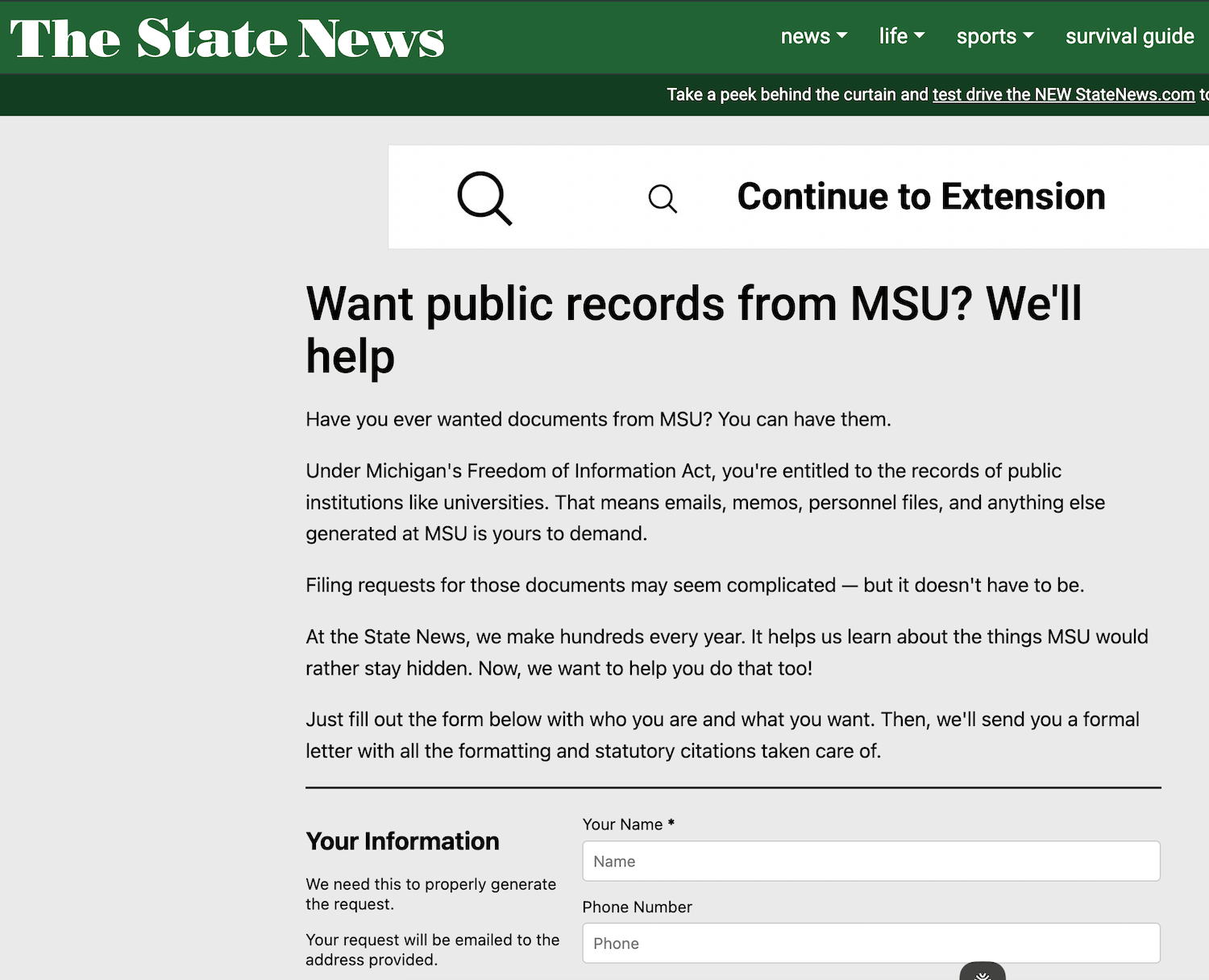
In addition to using open records for our reporting, we’ve also tried to make it easier for other journalists and everyday people to access this great tool.
We recently built something to make it easier to make FOIA requests to MSU. It’s a simple form where users enter their information and describe the records they want. Then, it emails the requester a sharp, legally sound request using our template with instructions for how to submit it to MSU.
So far, we’ve seen it used by other journalists working on stories, activists seeking evidence for their claims, and everyday people with random questions about MSU.
Our hope is that it has lowered the bar for filing first requests and made sure anyone with a curiosity worth investigating can exercise this wonderful right.
We encourage other college newspapers that want to make their public universities more transparent to talk to their web developers about doing the same.
Most of all, we want our fellow student journalists to treat FOIA with the excitement it deserves. An easy way to start is with SPLC’s FOIA Letter Generator, which creates requests tailored to your state’s laws.
So get out there and start filing!PreviousCreator journalism comes to campusNextCash-starved and censored, America’s student press is in crisis


bob@collegejournalism.org

Leave a comment