
J-schools are adding creator-focused courses, majors and dedicated centers while curriculum plays catch up with the industry
When Brooklyn-based freelance journalist Nicole Abriam took a startup journalism course at The New School in 2021, the assignment was straightforward: Build a product that serves a specific audience.
Leveraging the surge of writers moving to platforms like Substack and a void in nuanced coverage of the Filipino-American community, she launched Kultura, a newsletter covering that exact niche.
What started as a classroom assignment evolved into a senior capstone project, and eventually, a professional endeavor that she monetizes today through paid subscriptions.
In five years, Abriam wants to grow her newsletter into a social enterprise to support and highlight Filipino culture.
“There’s a growing market of creators who are switching to Substack and growing a business out of it,” said Abriam, who graduated from the New York City school with a journalism degree in 2022. “So I thought, ‘Why not do the same?’”
Abriam’s journey from student to creator journalist represents a burgeoning area of study, as a growing number of institutions are realizing they must adapt to the creator curriculum to stay relevant in a changing media industry.
“Schools are starting to recognize that their students are going to graduate into a very different media landscape than the one the curriculum was built for,” said Liz Kelly Nelson, Project C founder and a co-founder of The Independent Journalism Atlas. “There’s genuine momentum here. More schools are adding — or thinking about adding — creator-focused tracks, electives or at least weaving in entrepreneurial journalism concepts.”
For Blake Eskin, the chair of Journalism and Design at The New School (disclosure: The author obtained a graduate degree from this institution) and one of Abriam’s professors, the shift toward creator education is a response to a harsh industry reality: The days of assuming someone else will package and market a reporter’s work are largely over.
In his email newsletter course, Eskin argues that writing newsletters is a more comprehensive training tool than traditional articles because it forces students to master the “rhythm” of regular publication and the technical demands of a digital-first world.
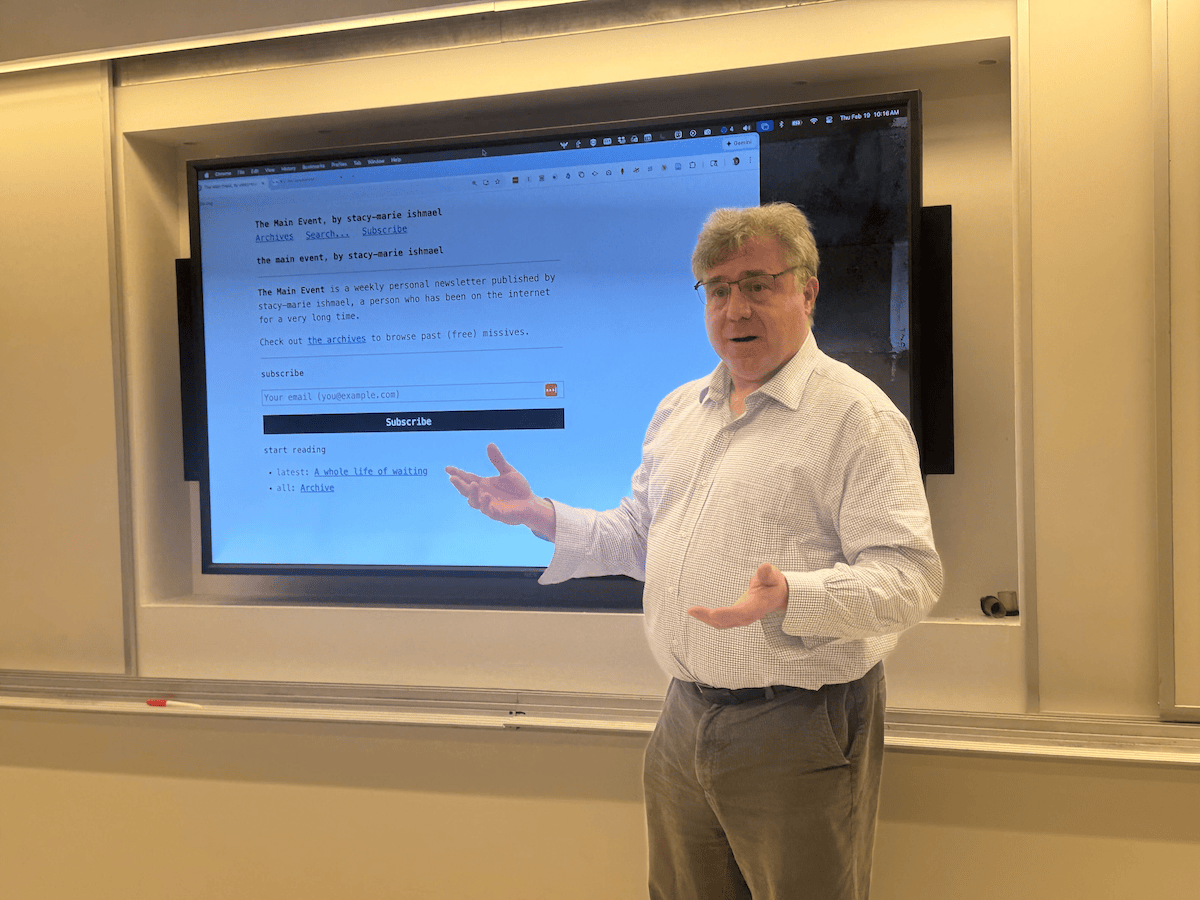
“You’re much more like Benjamin Franklin in that you’re the publisher and the typesetter and the photo editor and the interviewer and the proofreader and all those things at once,” Eskin said.
The course is structured around design prompts rather than editorial ones. Assignments range from technical exercises — such as using code blocks and headers or adhering to image permission protocols — to stylistic challenges like imitating a classmate’s voice.
“The biggest thing I need to teach our students is that journalism is not writing,” he said. “Journalism is collecting and interpreting and disseminating information for an audience in the service of the public. The word ‘writing’ doesn’t appear in that sentence.”
At Harvard Extension School, Ryan Kellett taught Content Creator Journalism in the summer of 2025, in which students came up with a launch plan for their channel.
Kellett said students were able to choose their medium, provided they accompany the content with editorial and business plans. He noted students were increasingly gravitating toward formats they interact with daily.
“To me, it’s easiest to get an A in the class by writing a sample newsletter as their final project,” Kellett said. “But 80% of the class last term chose to do video, often short-form video.”
With more than a third of journalists self-identifying as “creator journalists,” Kellett said journalism schools should “absolutely be in the business of giving students options.”
“Many students will end up in ‘regular’ jobs inside a whole host of different companies, but with ‘employee-generated content’ or EGC, they could be doing content creation as part of those roles too,” said Kellett, who’s also a co-founder of The Independent Journalism Atlas and an instructor for the Going Solo workshop.
This trend of creator-focused curriculum and dedicated facilities is also taking root at other major journalism programs. Nelson is a fellow at Arizona State University and George Washington University to build creator-focused program roadmaps.
Missouri School of Journalism has a Newsroom Content Creation course. Columbia College Chicago offers a Launching a Journalism Startup course. A Business of Media course is part of the “core context” journalism courses at the University of Oregon.
While many schools treat these skills as additional add-ons, St. Bonaventure University is codifying creation into its official academic catalog. This fall, the university will launch a dedicated content creation major.
Aaron Chimbel, the Jandoli School of Communication dean, said the new major is about providing a specific, branded pathway for students whose interests fall outside of traditional communication degrees.
Some of the program’s required courses are professional writing, video storytelling, graphic design, digital content and engagement, media law and ethics, and digital marketing — along with 400 hours of required internship. It culminates in an Advanced Content Creation course, a senior-level capstone experience.
While journalism students focus on reporting specifically for the public interest, content creation majors will learn to apply those same foundational skills — truth-telling, accuracy and communication — within corporate, entrepreneurial or nonprofit contexts.
“I’d love to see people, obviously, putting into practice how you create digital content, how you build a following, how you build an audience, how you connect with that audience,” Chimbel said.
This institutional commitment is backed by a $12.2 million renovation of the university’s facilities, which will open in the fall. The updated digital storytelling center is designed to foster the kind of cross-disciplinary collaboration that’s the hallmark of the creator economy.

“I think a lot of that will absolutely support this new major,” he said. “It’s really about providing a really strong grounding and the ability to adapt and move as the industries move.”
Meanwhile, Syracuse University opened its Center for the Creator Economy last year. It functions as a cross-campus resource, encouraging journalism students to pair their storytelling skills with business acumen by taking courses through the Whitman School of Management.
The center provides drop-in hours where students can access faculty with specific expertise, as well as equipment and recording areas to produce podcasts and other digital content.
Newhouse School of Public Communication Dean Mark Lodato said it’s important that the school helps students understand and leverage how the new approach to communicating intersects with journalism.
“I think, frankly, part of our obligation as a journalism school is to help teach our students how to reach their audience,” Lodato said.
With the center branded as “something that doesn’t exist anywhere else in higher education,” Lodato said he has been actively discussing these shifts with other journalism deans to develop similar programming nationwide.
“There are, I think, a growing number of schools and institutions that see this as an important place to be in the years ahead,” he said.
The shift toward a creator-driven curriculum is finding its most immediate application within student media organizations as they experiment with digital-first channels.
But for many newsrooms, this transition may be more than just a creative choice.
Andrea Lewis, president of the College Media Association and the director of student media at Ohio University, said as university budgets tighten, journalism programs are often forced to limit their staff, and curriculum and instruction on the business side is often the first to go.
This leaves a void that student journalists are now filling themselves by adopting the tactics of the creator economy.
Nelson agreed when asked about the No. 1 skill journalism schools are still failing to teach: “Revenue strategy. Full stop.”
“Students graduate knowing how to tell a story but with almost no understanding of how to monetize it,” Nelson said. “Whether that’s newsletters, memberships, sponsorships or diversified income streams – those conversations are barely happening in classrooms. You can have incredible journalism and still not be able to pay your rent.”PreviousThese community college journalists are giving incarcerated students a voiceNextSome of the best stories start with a FOIA request

Leave a comment