
How a USC student is ‘setting a precedent’ for newsletters and collegiate creator journalism
Tomo Chien’s newsletter has served multiple purposes.
He’s provided hard news exclusives, like mass layoffs at the University of Southern California. He’s also engaged with his audience over collegiate humor, like his yearly competition for subscribers to guess the following year’s tuition cost. This year, the winner earned $500 worth of credit at Cannabis House, a local dispensary.
Chien, a 22-year-old USC journalism student, is the creator of “Morning, Trojan,” weekday newsletter with five quick-hit story summaries about USC, Los Angeles and California. He says he has about 12,000 subscribers, and proudly calls Morning, Trojan the only student news outlet not supported financially by USC. Instead, it’s funded by donations and advertisements — $1,500 will get advertisers a month of banner ads, for example.
With content ranging from news scoops to irreverent humor, Morning, Trojan’s subscriber base, 70% open rate and independence has made it an outlier in the student media world. Through original reporting and aggregation, Chien has found, even with his audience changing every semester, a “core group of highly engaged subscribers,” he said.
Although student newspapers still reign supreme for news and journalism opportunities, Chien’s product is an example of an alternative route for students — and early-career journalists — to gain news experience and experiment with new revenue models.
“I came to college and started working for the student newspapers here and quickly realized that I think we were patting ourselves on the back, feeling like we were doing a great service for the community, when in reality, not a ton of people were reading the stories,” Chien said. “I was like, ‘OK, well, what is a format that’s going to get people to actually read the stories?’”
Competitive advantage
Piper Jackson-Sevy, co-founder of Flytedesk, a technology company that provides coaching, resources and national advertising to college media organizations, said there are “about 160” campuses with student media pushing out newsletters. (Disclosure: Flytedesk is a funder of the Student Press Report.)
“I don’t know of any others like Morning, Trojan — (newsletters) that are not started by the student newspaper,” said Jackson-Sevy. “At least, certainly not the numbers and response that Morning, Trojan has gotten.”
Christina Bellantoni, the director of USC’s Annenberg Media Center, a curricular news lab with student leadership at USC, met Chien during the first few weeks of his collegiate career.
“We have a lot of really talented people and a lot of really ambitious people, and among those, Tomo just stood out from the very beginning as the absolute top 1%,” Bellantoni said. “Sometimes, we’ll talk about motivating other students, and we’ll say things like, ‘Oh, they can be like Tomo,’ or hold up this example of something he’s done…. In a field of these incredible students, he is a singular talent.”
Chien worked for USC’s student newspaper, The Daily Trojan, for three semesters, starting in the fall of 2022. While there, he said he pitched the idea of a newsletter like Morning, Trojan to the editor-in-chief, but they passed, telling him it wasn’t a good fit.
So, he did it. During his freshman year, Chien wrote the newsletter for the Annenberg Media Center. But he broke away from the media center and attempted to replicate his process at other schools with College Brief, a nonprofit he started with the idea of student newsletters bringing news to multiple campuses.
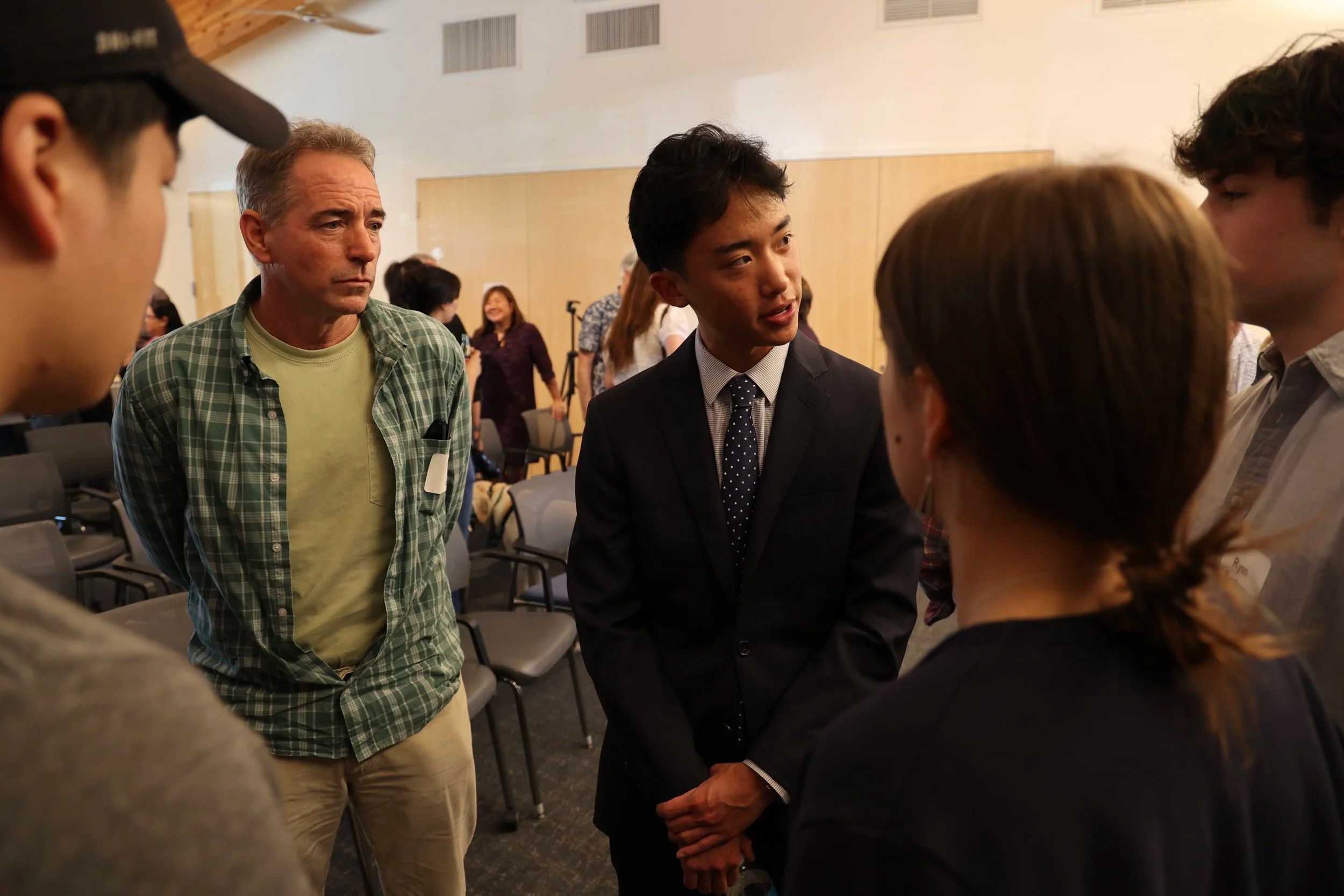
College Brief lasted 10 months and proved to be too challenging, which led Chien to focus on Morning, Trojan.
And that’s when the original reporting began, which directly correlated with its audience growing — an interesting content crossroads for Chien.
“I’m not sitting around thinking, ‘How can I maximize my audience growth?’ I am instead thinking, ‘How can I do something that’s gonna make myself and other people laugh?’” Chien said. “I think using that as a guiding instinct has been successful. … And to be clear, we have built our audience on the back of straight news reporting — previously sourced, deeply sourced reporting — and this was a — I don’t want to call it a problem — but it was a balance that I had to strike when I started to do the original reporting.”
In other words, Chien said, he recognized that he needed a division between his satire and his news reporting.
A team sport
When Dan Oshinsky, a newsletter expert who runs Inbox Collective, an email consultancy, was told how many subs Morning, Trojan has, he interjected.
“Wait. How many subscribers did you say they’re up to?”
About 12,000.
“That’s … that’s awesome.”
What really stood out to Oshinsky, he said after reading through Morning, Trojan, was the quality of the content, curation and reporting.
“It was clear to me that this team put in the work, and that’s not the case for every newsletter,” Oshinsky said.
The “team” is Chien and his editor, Anna Hsu, an electrical engineering and computer science student, with a role Chien called “thankless.” After scouring through anything from California news outlets to Reddit threads to find five stories at night, Chien wakes up at 6:30 a.m., writes, files to Hsu by 7:15 and sends that day’s newsletter to his e-list around 8 every weekday.
With the barrier of entry and cost for most newsletters being minimal, Oshinsky said he hopes students are not only noticing the USC students’ work but also planning to replicate it.
“I think a lot of people in this space will be looking at the Morning, Trojan team to (ask), ‘What did they do?’ Because, in some ways, they’re setting a precedent for the next generation of operators in this space,” Oshinsky said.
The future
Chien said from the outset his goal wasn’t for Morning, Trojan to last forever. With his graduation weeks away, the newsletter’s set to close in May, which he announced to his subscribers in a March 27 email.
It’s a problem spot in the student journalist space: What happens when a creator graduates? Replacing an audience with students who graduate is one thing — after all, there are potential new subscribers every semester — but replacing the content creator? Different territory.
Chien said he will bring his email list to L.A. Material, the media startup he’s joining after graduation. For now, though, he’s still churning out Morning, Trojan, reaching the audience he’s built through a bet on himself.
“Any campus media scene could use a little more competition,” Chien said. “A lot of schools are dominated by the student newspaper that’s been around for 100, 200 years and I think when you inject a little fun, a little competition, it’s better for everybody.”
Ashton Slaughter is a recent graduate of Oklahoma State University, where he received national awards for his work with The O’Colly, the student newspaper, and for his internship at the Tulsa World. He has also written for The Oklahoman and other outlets. PreviousA quarter million bylines, coming right upNextWhy I built a coalition for Philly’s student journalists

Leave a Reply